Liquidity Master
The order book, read off the chart: where stops and resting orders sit, drawn as a depth ladder beside price, with the biggest walls named and tracked.
About Liquidity Master
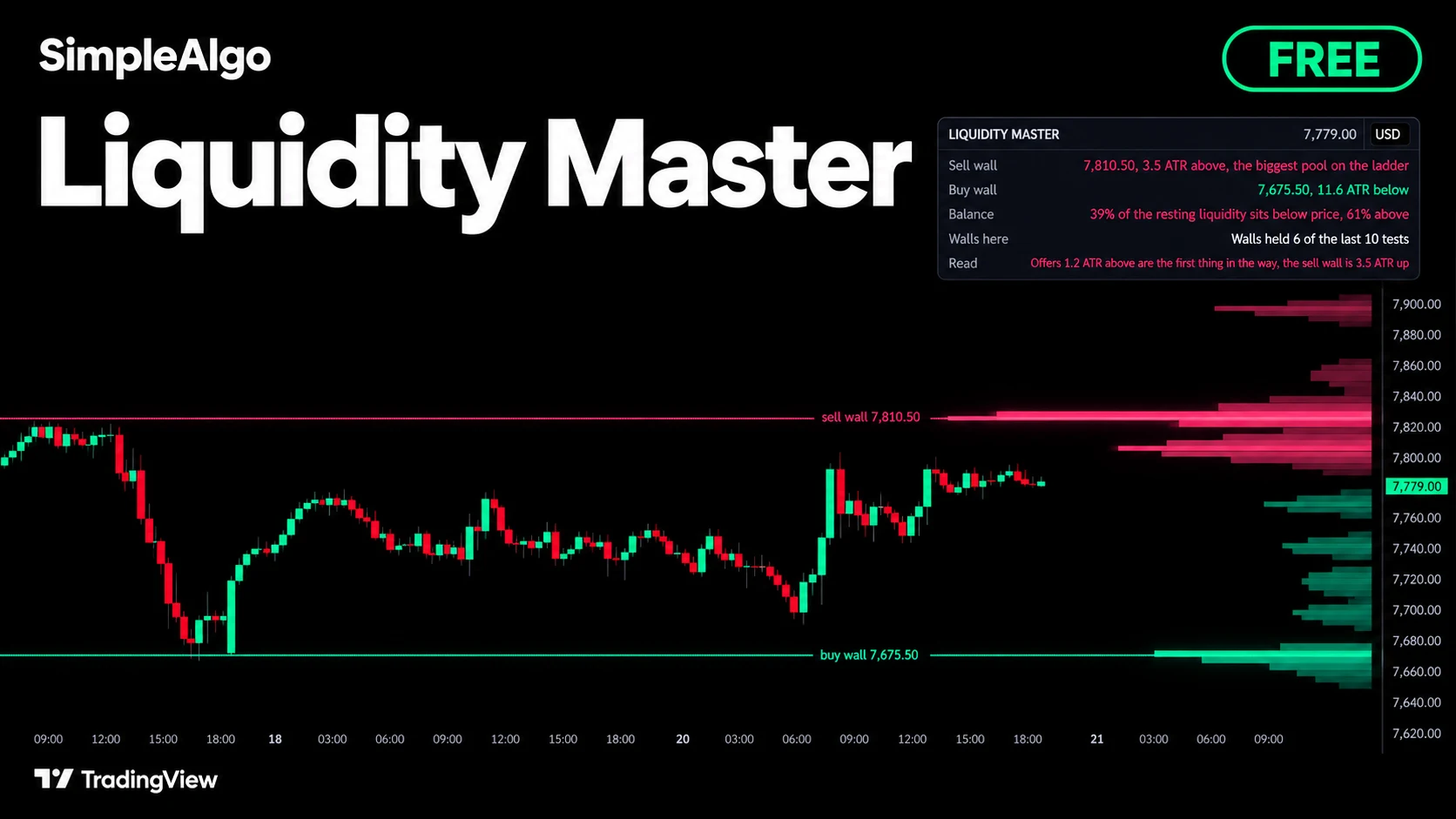
Liquidity Master is a free, open-source liquidity map for TradingView. Resting orders sit where traders put them: stops just past every swing high and swing low, and the bids and offers that showed themselves in rejected wicks. The script keeps every one of those pools, spends them as price trades through, lets them age out as orders get pulled, and draws what is left as a depth ladder beside price.
Bids sit below in one colour, offers above in another, and the longer the bar the more is resting there. The biggest pool on each side is named the buy wall and the sell wall, drawn as lines and tracked as price approaches.
Every time price reaches a wall, the test is judged on closes: back off and the wall held, close through and it broke. The panel keeps the score of how walls on this chart have held, and four alerts cover the events, all decided on closed bars.
What it does
- Depth ladder of resting liquidity drawn beside price
- Pools built from swing highs and lows and rejected wicks
- Pools spend as price trades through and age out as orders get pulled
- Buy wall and sell wall named, drawn and tracked
- Balance read: how much resting liquidity sits above vs below price
- A per-chart record of how walls held when price reached them
- Corner panel and four alerts, decided on closed bars
- Free and open source on TradingView
Want the full suite?
Liquidity Master is free forever. Premium members also unlock Pro Signals V5 and Simple Screener Pro, all granted straight to their TradingView account.
More free indicators
Profile Master
FreeA volume profile drawn as a cloud that travels with the chart, so you can see where value sits and how it moves.
Pullback Master
FreeA trend, and the pullbacks inside it, counted and graded: which pullback this is, how deep it went and whether it held cleanly.
Stream Master
FreeTrend drawn as a river: which way the market flows, how hard, how deep a turn has gone, and how long the move has run.