Best Indicator for Day Trading: What Actually Works in 2026
An honest comparison of the indicators day traders actually rely on — VWAP, volume profile, adaptive trend filters and momentum — and how to combine three of them.

Best Indicator for Day Trading: What Actually Works
There is no single best indicator, and any article that names one is selling something. What exists is a small set of tools that consistently earn their screen space intraday, and a much larger set that does not.
The short answer
If you keep three indicators intraday, keep these:
Everything else is refinement.
1. VWAP — the intraday reference price
Volume-Weighted Average Price is the average price paid today, weighted by volume. Institutions benchmark against it, which makes it self-reinforcing.
How to use it: above VWAP, favour longs; below it, favour shorts. Add standard deviation bands and the second band becomes a mean-reversion zone in a range and a trend-continuation shelf in a trend.
Where it fails: overnight and in the first minutes of the session, when there is not enough volume for it to mean anything.
2. An adaptive trend filter — direction without the lag
A fixed 20 EMA behaves identically in a dead range and a violent trend, which is exactly the problem. Adaptive trend tools widen when volatility rises and tighten when it falls, so they stop flipping on every candle in chop.
How to use it: it is a filter, not a trigger. Only take entries in its direction.
Where it fails: immediately after a gap or news spike, when volatility estimates are stale for a few bars.
3. A momentum oscillator — timing and exhaustion
RSI, MACD or a purpose-built oscillator tells you when a move is stretched and when momentum is diverging from price.
How to use it: for confirmation and divergence, never as a standalone reversal signal. "Overbought" in a strong trend means strength, not a short.
Where it fails: trending markets, where it pins at an extreme for hours.
Honourable mentions
What to leave off the chart
How to combine three without contradicting yourself
Give each tool one job and honour a hierarchy:
Trend filter  → decides direction (may I be long?)
VWAP / levels → decides location (is this a good price?)
Momentum      → decides timing (is now the moment?)
If the three disagree, there is no trade. That rule alone removes most losing intraday entries.
Frequently Asked Questions
What is the best indicator for day trading?
There is no single best one. VWAP for fair value, an adaptive trend filter for direction and a momentum oscillator for timing cover the three decisions an intraday trader has to make.
Is VWAP better than moving averages for day trading?
For intraday work, generally yes — VWAP is volume-weighted and resets each session, which makes it a more meaningful reference than a moving average carried over from previous days.
How many indicators should a day trader use?
Three is a sensible ceiling: one for trend, one for location, one for timing. More indicators tend to produce conflicting signals rather than better ones.
Do professional traders use indicators?
Many do, but as filters and context rather than automatic entry triggers. Risk management and execution matter far more than the indicator on the chart.
A pre-built version of this stack
SimpleAlgo packages exactly this structure — an adaptive trend filter, auto-marked levels, and confirmed non-repainting entry signals — into one TradingView overlay, so it uses a single indicator slot instead of three. Access starts from $5.77/week on the annual plan and every plan is covered by a 7-day money-back guarantee. See what is included.
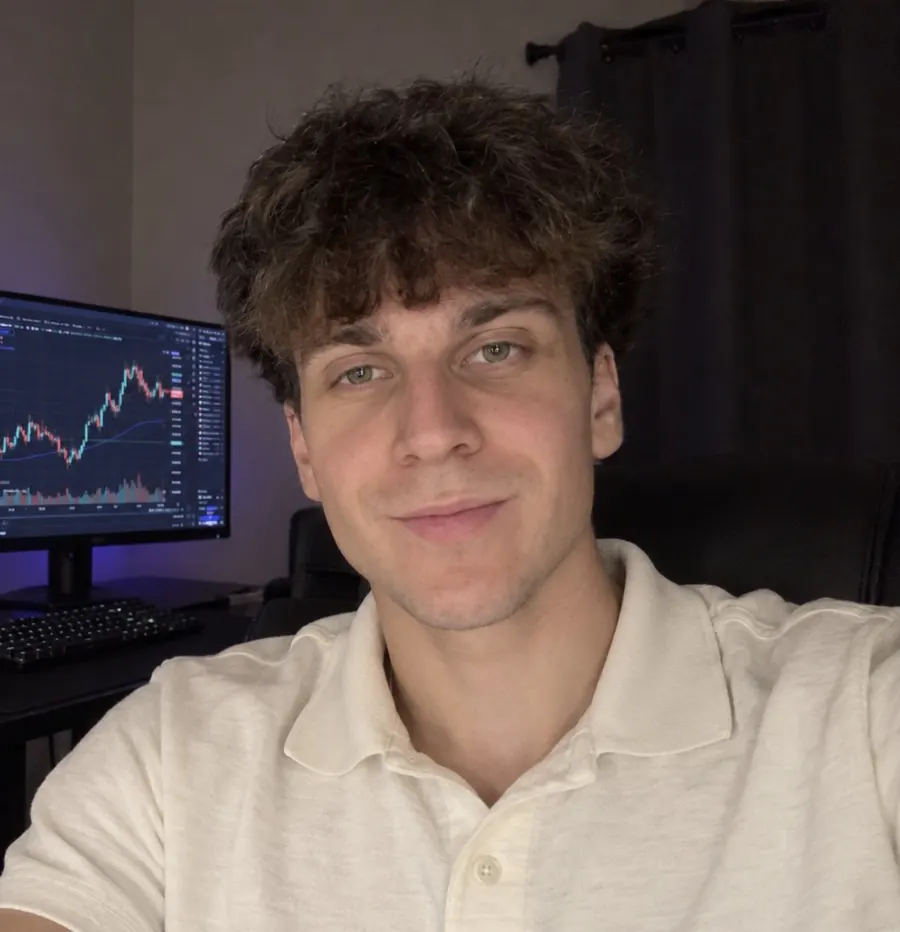
Written by
Nikolas MetreveliFounder of SimpleAlgo
Nikolas wrote his first real code at 12 and freelanced software tools and websites for small businesses before finding the markets at 15. He builds and maintains every SimpleAlgo indicator and writes these guides from hands-on use of the tools.
More about Nikolas and SimpleAlgoRelated Articles
How to Use TradingView for Day Trading: A Complete Setup Guide
The full day trading setup on TradingView — chart layout, timeframes, indicators, hotkeys, alerts and a repeatable session routine.
Best TradingView Indicators in 2026 (Free and Paid, Tested)
Which TradingView indicators are worth your chart space in 2026 — what each one actually measures, where the free ones fall short, and how to test any of them yourself in bar replay before you trust it.
How to Add an Indicator on TradingView (Step by Step)
The exact steps to add any indicator to your TradingView chart — built-in, community, and invite-only scripts — on desktop and mobile.
Related tools and guides
Next steps on this topic from the rest of the SimpleAlgo library.